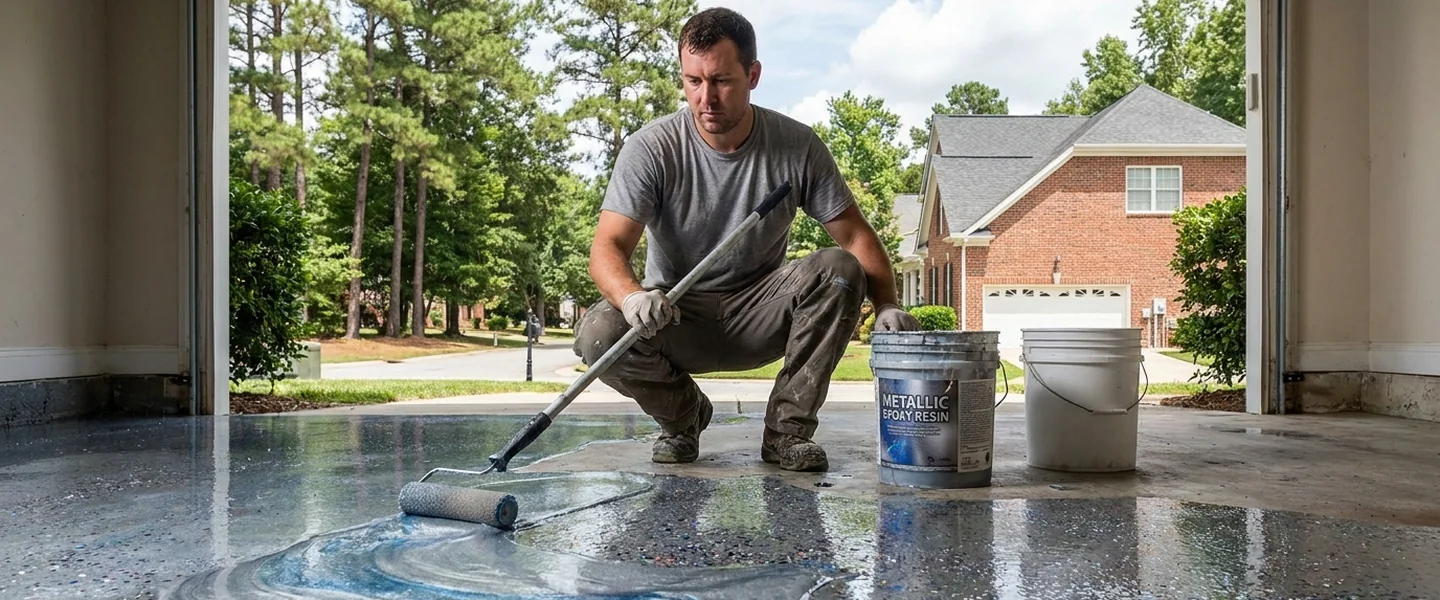
Concrete Floor Repair & Coating in Raleigh, NC
Cracks, spalls, pitting, and surface deterioration in Raleigh's older garage floors don't mean replacement — they mean professional repair and coating. We restore and protect worn concrete in Garner, Wake Forest, and across the Triangle.
Call (984) 252-4791 — Free EstimateWhy Older Raleigh Garages Need Repair Before Coating
Raleigh's suburban development history spans several generations of building. Communities like Garner, older sections of Wake Forest, and established Raleigh neighborhoods were built in the 1970s, 1980s, and 1990s. The garage slabs in these homes are now 30–50 years old — approaching or exceeding the typical service life of concrete that was finished to the lower quality standards of the era.
Decades of freeze-thaw cycling — Raleigh averages 15–20 freeze events per year — cause surface spalling as water enters micro-pores, freezes, expands, and pops the surface aggregate. Vehicle traffic with road salt and chemical exposure accelerates this process. Oil drips and chemical spills degrade the concrete surface chemistry over time. The result is a garage floor that looks rough, feels crumbling underfoot, and generates concrete dust with every sweep.
The good news is that the structural integrity of these older slabs is usually intact. Surface deterioration looks alarming but rarely penetrates more than half an inch into a slab that is otherwise stable. Professional surface repair — crack filling, spall patching, and grinding — addresses the surface condition without requiring slab replacement. Once repaired and coated, these floors look and perform better than new.
Concrete Repair Services We Provide
Crack Filling
Dormant cracks (not actively moving) are routed and filled with semi-rigid polyurea, which bonds to both crack faces and moves slightly with seasonal concrete expansion without re-cracking. Active structural cracks require engineering evaluation before coating.
Spall Repair
Spalled areas (where the surface layer has popped off) are cleaned of loose material, undercut to create a mechanical bond, and filled with polymer-modified repair mortar. The repair is feathered to match the surrounding surface level.
Pitting & Surface Pore Filling
Pitted concrete surfaces — common in older Raleigh-area garages — are addressed with a skim coat of epoxy primer that fills small pores and creates a uniform surface for the topcoat. This step is part of our standard preparation process.
Full Resurfacing Overlay
When surface deterioration is widespread — more than 30–40% of the floor affected — a thin epoxy overlay (sometimes called a skim coat system) may be specified instead of spot repairs. The overlay creates a fresh surface over the repaired substrate before the decorative coating system is applied.
Common Issues in Older Raleigh-Area Garages
Garner (1970s–1990s Construction)
Garner's working-class neighborhoods represent some of the oldest residential construction in the greater Raleigh area. Garage slabs from this era were typically poured to minimal thickness standards (3.5–4 inches), without vapor barriers, and finished to relatively rough surface profiles. After 30–50 years, these floors commonly show widespread surface spalling, significant crack patterns, and oil-saturated zones from decades of vehicle drips. Our repair and coating process addresses each of these conditions systematically.
Wake Forest (1980s–1990s Mixed Construction)
Older Wake Forest neighborhoods — particularly those predating the Heritage development — have a similar construction timeline and show comparable concrete deterioration. Freeze-thaw damage is visible in surface pop-outs, and older control joints that were not properly sealed have allowed moisture infiltration and edge spalling.
Newer Construction (Post-2000)
Even newer Raleigh-area homes can develop concrete issues. New construction slabs that were poured in wet conditions, insufficiently cured, or subjected to early traffic can show surface delamination (where the top layer separates from the body of the slab). We encounter this in communities across Apex, Knightdale, and North Raleigh. The repair approach is the same — remove the failed surface layer through grinding and restore before coating.
When Repair Is (and Isn't) Enough
At your free estimate, we assess the structural condition of your slab alongside the surface condition. There are situations where the right advice is not to coat the floor at this time:
- Active structural cracks (cracks that are growing or showing vertical displacement) should be evaluated by a structural engineer before coating. Coating over an active structural crack will result in the crack telegraphing through the coating.
- Slab heaving or settlement — if sections of the slab are at different elevations, self-leveling underlayment may be needed before coating can be applied. We'll identify this at the estimate stage.
- Active water intrusion — water entering the garage through wall-floor joints or rising through the slab during rain events requires waterproofing intervention before coating.
We give honest assessments. If your floor needs work beyond what we do, we'll tell you — not sell you a coating over a problem that will cause it to fail.
Get an Honest Assessment of Your Raleigh Garage Floor
Call us for a free on-site evaluation. We'll tell you exactly what your floor needs — repair, coating, or both.
Call (984) 252-4791 — Free EstimateFrequently Asked Questions
Can you coat a floor with cracks and spalling without replacing the slab?
In the vast majority of cases, yes. Surface cracks and spalling are cosmetic and shallow — they don't indicate structural failure. Our repair process addresses these conditions at the surface level, and the coating system locks in the repair. Slab replacement is rarely necessary for typical residential garage deterioration.
How do you repair cracks so they don't show through the coating?
Cracks are routed to create clean, consistent edges, then filled with semi-rigid polyurea, which is slightly flexible and bonds tightly to the concrete. After the polyurea cures, the surface is ground flat across the repair zone. When the flake chip broadcast layer is applied, the crack location becomes invisible within the decorative texture.
My garage floor has oil stains from 30 years of vehicles — is that a problem?
Yes, but it's manageable. Oil-saturated concrete must be cleaned with a chemical degreaser and then ground to remove oil from the surface pores before coating. Deep oil contamination that has penetrated far into the slab can cause adhesion issues even after cleaning — we test for this at the estimate stage using a simple water absorption test. In severe cases, a containment coat of specialized sealer is applied before the standard system.
What's the difference between crack filling and slab replacement?
Crack filling addresses surface and through-cracks that are structurally dormant — the crack edges are not moving relative to each other. Slab replacement is necessary only when the concrete has lost structural integrity: severe heaving, settlement, widespread structural cracking with vertical displacement, or aggregate degradation through the full slab depth. The vast majority of residential garage situations call for repair, not replacement.
Does concrete repair add to the installation time?
Yes — repair mortar and polyurea crack filler require cure time before grinding and coating can proceed. For projects with significant repair work, we may schedule a prep day followed by coating the following day. We build repair time into the project schedule at the estimate stage so there are no surprises.
How do you know if a crack is structural or just cosmetic?
We evaluate cracks based on several factors: width, orientation, depth, evidence of vertical displacement (one side higher than the other), and whether the crack is growing (evidenced by previous patching attempts that have re-cracked). Hairline cracks running parallel to control joints are typically concrete shrinkage cracks and are cosmetic. Diagonal cracks at door corners or cracks with vertical displacement warrant closer inspection.
Do you offer concrete repair without a full coating?
We typically combine concrete repair with a coating system because leaving repaired concrete uncoated exposes the repairs to the same conditions that caused the original damage. A bare concrete patch in an uncoated floor will not last as long as a patch sealed under an epoxy system. That said, we discuss all options at the estimate stage and let you make an informed decision.
My floor has old paint on it — can it be coated over?
No — existing paint or sealer must be completely removed before our system can be applied. Diamond grinding typically removes old paint efficiently. In cases where a thick latex or epoxy paint layer is present, chemical stripping may precede grinding. Coating over existing paint is a shortcut that causes delamination failure — we never do it.