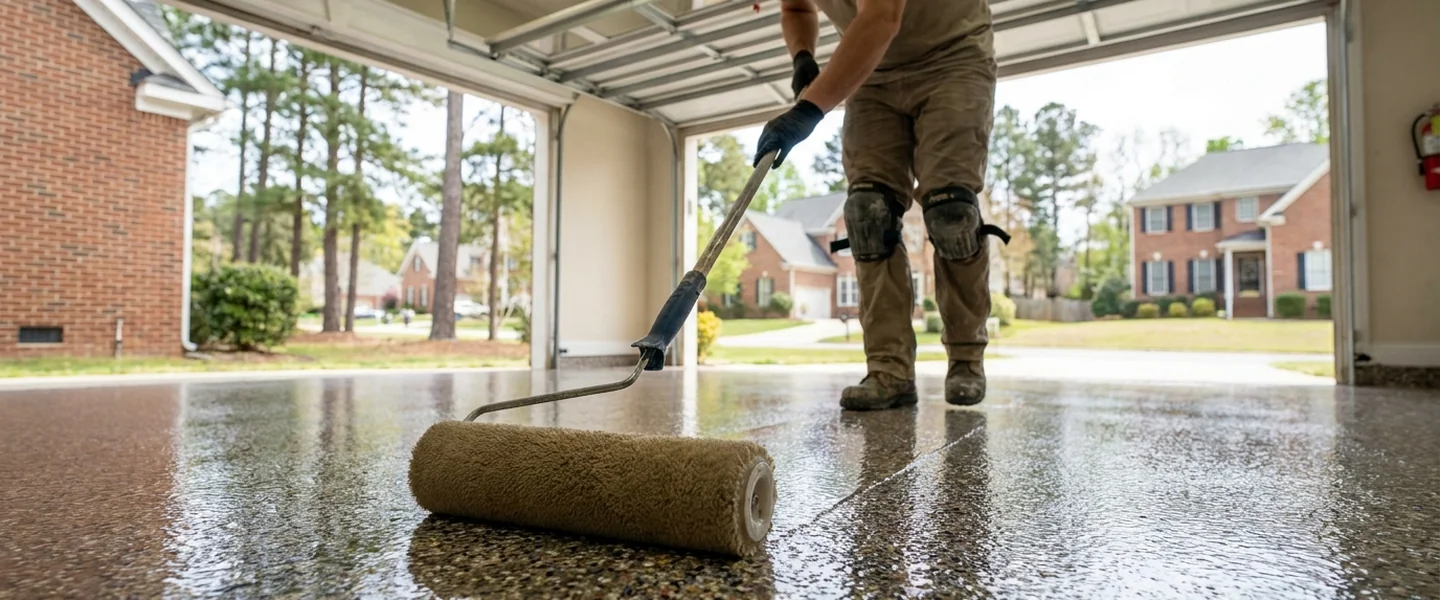
Polyaspartic Floor Coating in Raleigh, NC
The fastest, most durable floor coating available — one day to install, park on it the next morning. UV-stable against NC sun, hot-tire resistant for Raleigh's summer heat, and built to last decades.
Call (984) 252-4791 — Free EstimateWhat Is Polyaspartic Floor Coating?
Polyaspartic is a second-generation aliphatic polyurea coating — a significant advancement over both standard epoxy and traditional polyurethane systems. It was developed for industrial and commercial environments where floors needed to be back in service within hours, not days. Today, polyaspartic systems are the premium choice for Raleigh homeowners who want the absolute best in speed, durability, and UV performance.
Unlike standard epoxy systems, which require 24–72 hours between coats and a full seven-day cure before heavy traffic, polyaspartic coatings cure rapidly. A full polyaspartic system — surface prep, base coat, flake broadcast, and topcoat — can be completed in a single day. The floor is typically ready for foot traffic within 2–4 hours of the final coat and ready for vehicle traffic by the next morning.
For Raleigh's active-lifestyle homeowners — those converting garages into home gyms, woodworking workshops, or multi-use living spaces — polyaspartic eliminates the 3–5 day disruption of a traditional epoxy system. You get your garage back faster, and the finished product is superior in nearly every measurable performance category.
Why Polyaspartic Outperforms Standard Epoxy in Raleigh
UV Stability — Critical for North Carolina Sun
Standard epoxy coatings are aromatic compounds — they yellow and chalk when exposed to UV radiation. In Raleigh, where garages with south-facing or east-facing windows receive intense sunlight, aromatic epoxy topcoats can show noticeable yellowing within one to two years. Polyaspartic coatings are aliphatic — they are UV-stable by their chemistry, maintaining color and gloss indefinitely under direct UV exposure. For garages with natural light, polyaspartic is the only correct topcoat choice.
Hot-Tire Pickup Resistance — Essential for Raleigh Summers
Hot-tire pickup is what happens when a vehicle is parked on a coating while the tires are still hot from driving. The heat softens the coating surface, and the tire rubber bonds to it. When the vehicle pulls out, the coating pulls up with it. This is a well-documented failure mode of polyurethane and lower-grade epoxy topcoats in hot climates. Polyaspartic topcoats have a glass transition temperature (Tg) significantly higher than polyurethane, making hot-tire pickup essentially a non-issue even in Raleigh's 100°F summer garages.
Flexibility Across Temperature Ranges
Raleigh's climate includes cold January nights where garage temperatures can drop below freezing. Traditional epoxy becomes brittle in cold temperatures and can crack when the underlying concrete expands and contracts. Polyaspartic maintains flexibility across a wide temperature range — typically -40°F to 250°F — making it suitable for Raleigh's full seasonal temperature swing without adhesion or flexibility concerns.
Standard Epoxy System
- 2-day minimum install
- Aromatic topcoat yellows in NC sun
- Hot-tire pickup risk in summer
- Full cure: 5–7 days
- Good durability
Polyaspartic System (Our Premium)
- Single-day install
- UV-stable — never yellows
- Hot-tire resistant, high Tg
- Vehicle-ready next morning
- Superior durability and flexibility
The Raleigh Polyaspartic Installation Process
Surface preparation is identical to our full epoxy system — we do not cut corners because the topcoat is faster. Diamond grinding, MVE testing, moisture primer (when indicated), and crack/spall repair are all completed before any coating is applied. The speed advantage of polyaspartic comes from the coating chemistry, not from skipping prep steps.
- Morning: Diamond Grinding & Surface Preparation — CSP 2–3 profile, HEPA vacuum, repairs completed
- Mid-Morning: MVE Primer (if needed) — Applied when moisture vapor readings exceed threshold
- Late Morning: Polyaspartic Base Coat — First coat applied and flake broadcast to rejection
- Afternoon: Scrape, Vacuum & Topcoat — Excess flake removed, first topcoat applied
- Late Afternoon: Second Topcoat — Final protective coat applied, anti-slip aggregate added if requested
- Evening: Foot Traffic — Floor is ready for light foot traffic within 2–4 hours of final coat
- Next Morning: Vehicle Traffic — Pull your vehicle back in the following morning
Ideal Candidates for Polyaspartic in Raleigh
Polyaspartic is the right choice for homeowners who need one or more of the following:
- Quick return to service — minimal disruption to daily life
- Garage with natural light exposure — UV stability matters
- Active vehicle use — multiple parking cycles daily mean hot-tire resistance is critical
- Home gym or workshop conversion — floor must handle equipment weight and cleaning chemicals
- Upscale finish for Holly Springs or Cary home with premium garage goals
- Commercial or semi-commercial use — body shop, home business, high-traffic space
Same-Week Polyaspartic Installation Available
Call Raleigh Epoxy Floor Pros today for a free on-site estimate. Most polyaspartic projects can be scheduled within the same week of your estimate.
Call (984) 252-4791 — Free EstimateFrequently Asked Questions
How fast does polyaspartic cure in Raleigh's climate?
Polyaspartic cures faster in warmer temperatures, which makes Raleigh's summers an advantage. In summer conditions, foot traffic is often possible within 2 hours of the final coat. Vehicle traffic is typically ready the following morning — faster than a traditional epoxy system by 24–48 hours.
Is polyaspartic truly a one-day system?
Yes — in most residential garage situations, the full system from grinding through final topcoat is completed in a single day. Larger garages (3+ cars, 900+ sq ft) may require an early start. We'll give you an accurate schedule at your free estimate.
Will polyaspartic yellow in Raleigh's sun?
No. Polyaspartic is an aliphatic compound, meaning it is inherently UV-stable. It will not yellow, chalk, or fade under direct sunlight. Standard epoxy topcoats are aromatic and will yellow — polyaspartic will not. This is especially important for Raleigh garages with windows, skylights, or south-facing doors.
Does polyaspartic still require diamond grinding and moisture testing?
Absolutely. Surface preparation requirements for polyaspartic are identical to our standard epoxy system. Diamond grinding to CSP 2–3, MVE testing, moisture primer when indicated, and all crack/spall repairs are completed before any coating is applied. Fast cure does not mean cutting prep steps.
How does polyaspartic handle NC winters?
Polyaspartic maintains flexibility down to temperatures well below freezing, unlike standard epoxy which becomes brittle in cold conditions. Raleigh's freeze-thaw cycles — cold nights in January and February — do not present a delamination risk with polyaspartic systems properly bonded to a prepared slab.
Can polyaspartic be applied to a concrete floor with moisture issues?
Yes — when a moisture-mitigation primer is applied first. Polyaspartic alone is not a vapor retarder, but when installed over a penetrating epoxy moisture primer on a properly ground slab, the system performs well even in high-MVE environments like Raleigh's clay-soil garages.
Is polyaspartic more durable than standard epoxy?
In most performance categories, yes. Polyaspartic has higher abrasion resistance, better UV stability, superior hot-tire resistance, and greater flexibility. It is the coating used in commercial and industrial environments where performance is non-negotiable. For residential garages, it represents a meaningful upgrade over standard epoxy systems.
What color options are available with polyaspartic systems?
Polyaspartic topcoats work with the same full range of vinyl chip blends available with our standard epoxy base coats. You choose your chip color and density; the polyaspartic seals and protects the flake layer regardless of color choice. Custom blends can be viewed at your free on-site estimate.